In the run-up to the Shift/HR Learning & Talent Development Conference on 17 June, we have published an article series on how AI is changing learning, knowledge work and capability building. Jan Foelsing recently addressed the cognitive and design side of the challenge in a conversation on Vibe Learning and friction architecture. In this interview we add the organisational perspective: what does the AI shift mean for the strategic positioning of L&D itself?
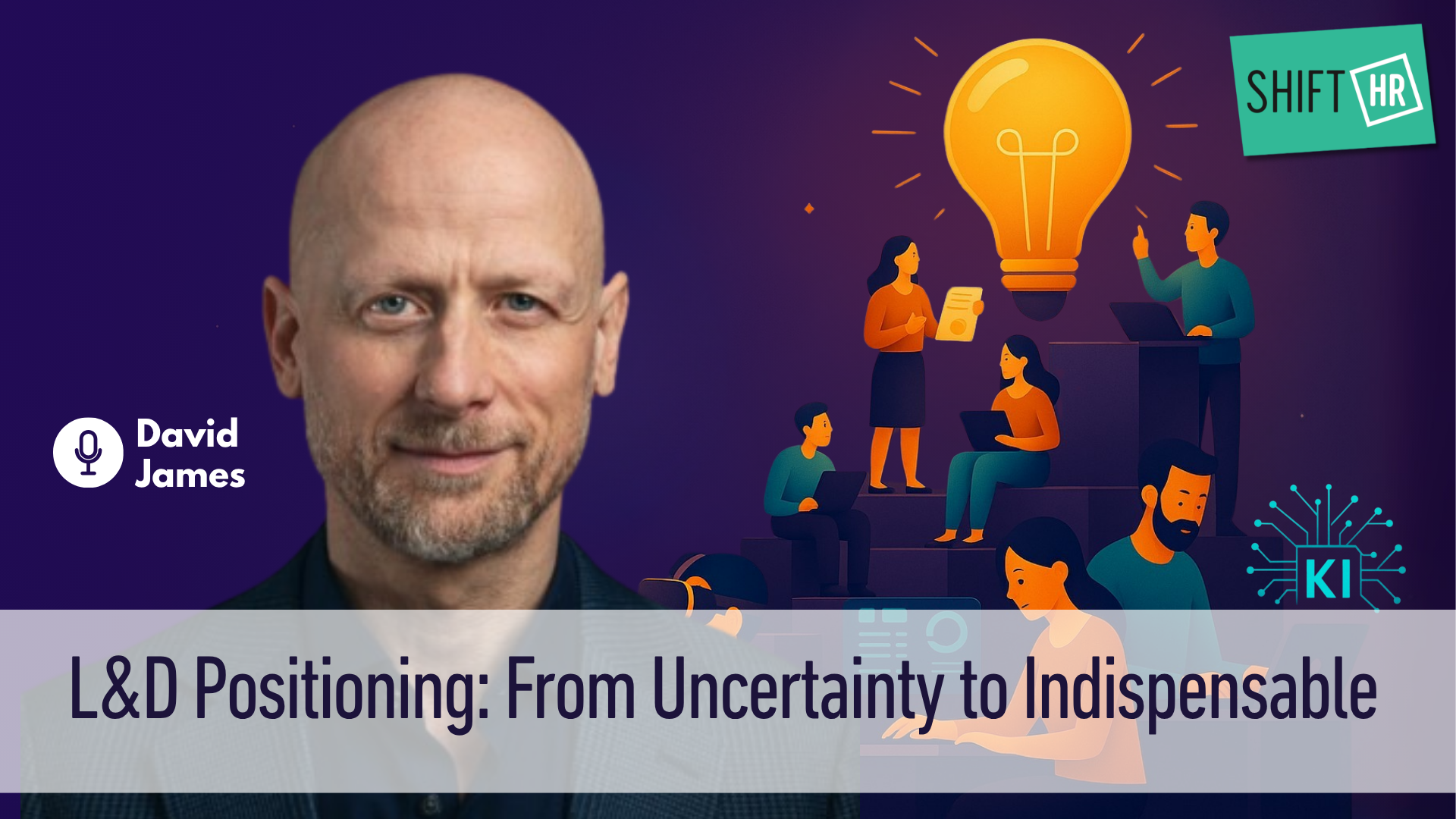
 David James is Chief Learning Officer at 360Learning and host of The Learning & Development Podcast. He has worked in people development for more than 20 years, including as Director of Talent, Learning & OD for The Walt Disney Company across Europe, the Middle East and Africa. In his work, he focuses on how L&D can create visible business impact and how the function can earn the strategic position it deserves.
At the conference, David's opening talk is titled: “From Uncertainty to Indispensable: How L&D Leaders Stay Relevant in the Age of AI.” Ahead of the session, we spoke with him about the content factory problem, the strategic mandate for L&D and why building influence matters more than adopting new role models.
Content Factory: how bad is the problem really? Or is that a caricature that misses most L&D teams?
David James: The problem is very real. The expected and requested version of L&D in many, if not most, organisations is an L&D shopfront of programs and content in an LMS. When L&D is engaged, it’s to create and deliver a program.
Maybe the term “content factory” doesn’t resonate because it’s slightly disparaging, but it is used to create urgency. The problem is that business leaders are asking the same question across the board: “Can AI do that?”
And as far as producing L&D content is concerned, the answer is: yes, AI can do that.
But there is another, more secure and valuable role that L&D can play.
If L&D needs to be a strategic partner: what does that actually require L&D to deliver? What’s the new mandate?
David James: To become a strategic partner, L&D needs to align with leadership to ensure it is integrated into the business strategy. To take their seat at the elusive table, if you will.
The problem is that the expected and requested version of L&D is far from strategic and can be viewed more as a perk, or a benefit. A nice-to-have.
L&D needs to stand for more than “providing learning” and consult with stakeholders to understand the root causes of performance and skills gaps. But they need to do this with skill, tact and savvy.
Power dynamics in organisations mean the role of strategic partner will not be given but must be hard earned.
Bersin frames this new role as the Learning Architect: ecosystem designer, enablement strategist, knowledge architect. Is that the strategic role you’re asking L&D to step into? And how do we actually get there?
David James: I don’t think we need to reinvent L&D to become more strategic. It’s more useful to realise where any of us are at this present time and work from there.
We need to first decide that we need to grow our influence and do so by being relied upon for meaningful impact. To leverage those successes to get us closer to senior stakeholders and, from there, ensure that we are capable and confident in helping them enhance performance and close their skills gaps.
Once we’ve banked successes, the logical next step can be to align L&D to the business. From then on, we are truly strategic.
By focusing too much on new roles, we can delay alignment.
The Learning Architect has to own the ecosystem — but the knowledge systems sit in IT, the content sits in business units, and leadership still comes with “build me a course.” How do you actually execute that mandate?
David James: First with mindset. We have to believe that our role is to help the business “win” by ensuring people are ready and the workforce can be agile.
Secondly with skill. Consulting and analysis are the cornerstone of the profession now, so our ability to identify root causes, manage stakeholders, make impact and amplify our successes will be the key.
When we’ve proven we are able to affect performance and close skills gaps, we can take more of the mandate.
That shift doesn’t happen in L&D alone. Who needs to change their thinking more: L&D itself, or the business?
David James: L&D needs to own this. We can change the mind of the business via our successes and by growing our relationships and our influence.
No L&D leader has ever had the ideal situation handed to them on a plate. It’s always been earned. Hard earned.
David James speaks on 17 June at the Learning & Talent Development Conference with the talk “From Uncertainty to Indispensable: How L&D Leaders Stay Relevant in the Age of AI”. Further reading from the conference series: what remains as the task for L&D, what learning theory derives from the shift and the conversation with Jan Foelsing on Vibe Learning and friction architecture.
Jetzt kostenlos für Freemium-Zugang zur Shift/HR-Plattform registrieren!
- Zugang zu Freemium-Inhalten der Mediathek
- Drei Credits für Freischaltung von Premium-Inhalten
- Monatlicher Content-Newsletter mit Premium-Inhalten
- Zugang zu geschlossener Linkedin-Gruppe
- Besondere Plattform-Angebote über Shift/HR Updates
- Kostenlos für immer!
Wir legen großen Wert auf sachliche und unabhängige Beiträge. Um nachvollziehbar zu machen, unter welchen Rahmenbedingungen unsere Inhalte entstehen, geben wir folgende Hinweise:
- Partnerschaften: Vorgestellte Lösungsanbieter können Partner oder Sponsoren unserer Veranstaltungen sein. Dies beeinflusst jedoch nicht die redaktionelle Auswahl oder Bewertung im Beitrag.
- Einsatz von KI-Tools: Bei der Texterstellung und grafischen Aufbereitung unterstützen uns KI-gestützte Werkzeuge. Die inhaltlichen Aussagen beruhen auf eigener Recherche, werden redaktionell geprüft und spiegeln die fachliche Einschätzung des Autors wider.
- Quellenangaben: Externe Studien, Daten und Zitate werden transparent kenntlich gemacht und mit entsprechenden Quellen belegt.
- Aktualität: Alle Inhalte beziehen sich auf den Stand zum Zeitpunkt der Veröffentlichung. Spätere Entwicklungen können einzelne Aussagen überholen.
- Gastbeiträge und Interviews: Beiträge von externen Autorinnen und Autoren – etwa in Form von Interviews oder Gastbeiträgen – sind klar gekennzeichnet und geben die jeweilige persönliche Meinung wieder.